


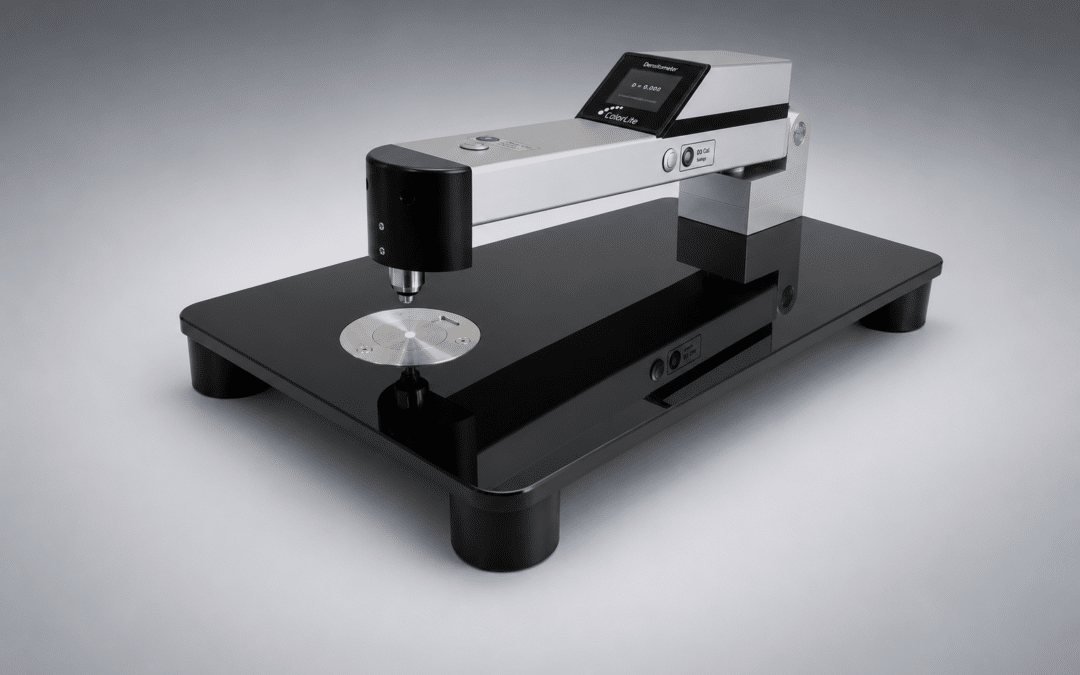
Why a Densitometer Measures Light Transmission First – and Then Calculates Optical Density
Many people associate the term density with a physical property such as mass or weight. In densitometry, however, density has a completely different meaning.
A densitometer does not measure the material density of a sample. It is not concerned with whether a material is “heavy” or “light”. Instead, it determines how strongly a sample attenuates light. This quantity is known as optical density and plays an important role in numerous industrial applications, including optical filters, technical films, display and instrument films, and other transparent materials.
So how is an optical density value actually obtained?
The answer surprises many people.
A densitometer does not measure optical density directly as its first measurement.
A Densitometer First Measures Light Transmission
The measurement process begins by determining the light transmission of the sample.
To do this, the sample is placed between a light source and a detector. As light passes through the material, part of it is absorbed or scattered. The detector measures the remaining amount of transmitted light. This value is referred to as transmission and describes how much light passes through the sample.
The more light reaches the detector, the higher the transmission. The less light passes through the sample, the more strongly the material attenuates the light.
Based on this transmission measurement, the densitometer then calculates the optical density.

Fig. 1: Principle of transmission measurement. Depending on the light transmission of the sample, different amounts of light reach the detector. This measured transmission forms the basis for calculating the optical density.
Optical Density Is Calculated from Light Transmission
Once the transmission has been measured, the densitometer calculates the optical density using a logarithmic equation:
D = −log₁₀(T)
Here, T denotes the measured transmission. It is defined as the ratio of the transmitted light intensity to the incident light intensity.
This mathematical relationship is based on the Bouguer–Lambert–Beer law, named after the scientists Pierre Bouguer (1698–1758), Johann Heinrich Lambert (1728–1777) and August Beer (1825–1863). It describes the relationship between the attenuation of light and the properties of the medium through which the light travels.
From a practical perspective, the key takeaway is simple: the less light passes through a sample, the higher its optical density. This relationship becomes immediately apparent when comparing transmission with optical density.
| Optical Density | Transmission |
| D0 | 100 % |
| D1 | 10 % |
| D2 | 1 % |
| D3 | 0,1 % |
| D4 | 0,01 % |
| D5 | 0,001 % |
| D6 | 0,0001 % |
Each increase of one optical density unit means that only one tenth of the previous amount of light passes through the sample.
Why Optical Density Matters
Optical density is important wherever materials are designed to transmit or attenuate light in a controlled manner. Typical examples include optical filters, technical films, display components, and printed transparent materials.
To ensure these products perform their intended function reliably, their optical properties must be reproducible. Measuring optical density objectively makes it possible to verify these properties, document the results, and compare them with defined acceptance limits.
The ColorLite sd350 Delivers More Than Just an Optical Density Value
The ColorLite sd350 is a spectral transmission densitometer. It measures the light transmitted through a sample across the visible wavelength range from 400 to 700 nm and calculates the optical density from these measurements.Because the instrument captures the complete transmission spectrum, the same measurement provides more than just optical density values.
It can also calculate and display colour values such as CIE L*a*b*, XYZ and Yxy. As a result, users obtain information about both the light transmission and the colour of transparent or translucent materials without the need for a second measurement.
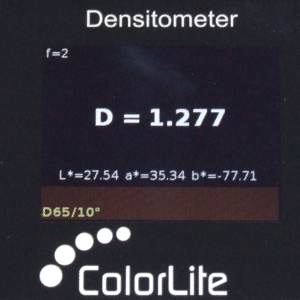
Fig. 2: Display of a ColorLite densitometer showing the measured optical density (D = 1.277) and the CIE L*a*b* colour values of the sample.
The integrated dual-channel system provides a wide measurement range and high measurement accuracy. Depending on the optical density of the sample, the sd350 automatically switches between two measurement channels. This enables reliable and reproducible measurements across an optical density range from D0 to D6.
Depending on the instrument configuration, the ColorLite sd350 can be used for both transmission measurements of transparent materials and reflection measurements of surfaces.
In transmission mode, the instrument measures the light passing through the sample. From the measured transmission spectrum, it calculates both the optical density and colour values such as CIE L*a*b*, XYZ and Yxy.
In reflection mode, the sd350 performs spectral colour measurements of surfaces. For this purpose, it can optionally be equipped with a 45°/0° measuring geometry for reflected-light measurements. Both measurement modes are based on the same spectral measurement principle but are selected according to the application and are not performed simultaneously.
Depending on the instrument configuration and the selected measurement mode, the ColorLite sd350 therefore combines the capabilities of a transmission densitometer with those of a spectral colour measurement instrument.
Summary
A densitometer does not measure optical density directly.
Instead, it first measures how much light passes through a sample. The optical density is then calculated from this transmission measurement.
Understanding this measurement principle makes it easier to interpret measurement results and explains why modern spectral measurement systems can extract far more information from a single transmission measurement than just an optical density value. In addition to optical density, they can also calculate and document colour values.
Whether measuring technical films, optical filters, displays or other light-transmitting materials, objective optical density measurement provides the foundation for reproducible quality, traceable decisions and reliable communication throughout the entire process chain.
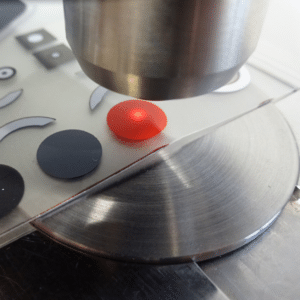
Fig. 3: Precise optical density measurement of a printed film. The measured light transmission forms the basis for calculating the optical density.
FAQ
What does a densitometer measure?
A densitometer measures the light transmission (transmittance) or, depending on the instrument, the light reflected by a sample. From these measurement data, it calculates the optical density. Modern spectral densitometers capture the complete visible spectrum, allowing them to calculate not only optical density but also colour values from the same measurement.
What is the difference between transmission and reflection?
In transmission measurements, the instrument measures the light that passes through a transparent or translucent sample. This method is commonly used for applications such as films, optical filters and thermal transfer ribbons.
In reflection measurements, the instrument analyses the light reflected from a surface. This method is commonly used for applications such as printed materials and coatings.
How is optical density calculated?
Optical density is calculated from the measured light transmission (transmittance) using the formula D = −log₁₀(T). The lower the transmission, the higher the optical density. This logarithmic relationship enables optical density to be measured accurately over a wide range of light attenuation.
What do D0 to D6 mean?
The D-values describe how strongly a sample attenuates light. Each increase of one optical density unit means that only one tenth of the previous amount of light passes through the sample. A measurement range from D0 to D6 enables reliable measurements of both highly transparent and highly light-absorbing materials.
Can a densitometer also measure colour?
Yes. Spectral densitometers such as the ColorLite sd350 capture the complete transmission spectrum. From this single measurement, they can calculate and display not only the optical density but also colour values such as CIE L*a*b*, without requiring an additional measurement.
What applications are densitometers suitable for?
Densitometers are used wherever the optical density of transparent or translucent materials needs to be measured objectively. Typical applications include:
- Thermal transfer ribbons
- Printing films and printing masters
- Labels
- Packaging films
- Instrument dials and control panels
- Optical filters
- Transparent engineering plastics
Would you like to measure the optical density of your materials objectively?
Every application has its own requirements. That is why we support you from the very beginning – from selecting the right measurement system to assisting with the validation of your measurement process, if required.
✓ Measurement of your original samples
✓ Application-specific advice
✓ Support with comparative measurements and validation
✓ Instrument training and commissioning support
→ Contact the ColorLite Sales Team
→ Learn more about the ColorLite sd350 – Technical information about the sd350 densitometer
