


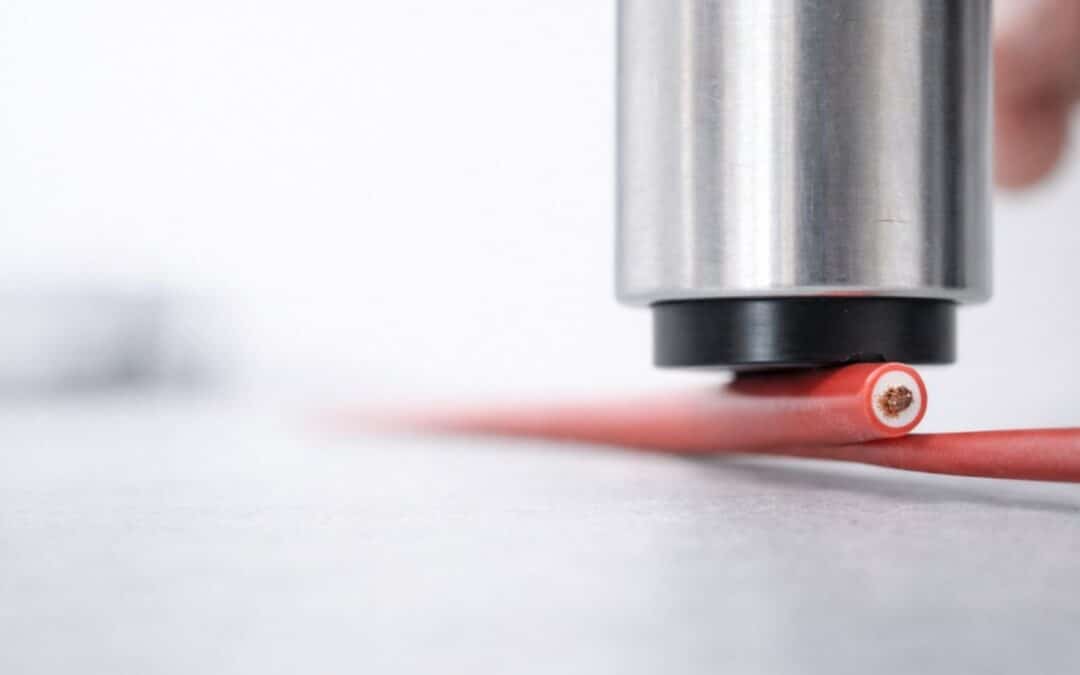
Cable colours are far more than an aesthetic feature. In many applications, they fulfil a technical and safety-relevant function: they enable the clear identification of cables, even when these are physically identical in structure. Even minor colour deviations can lead to cables being confused or incorrectly assigned – with potential consequences for safety, function and compliance with standards.
However, a purely visual assessment is not sufficient for this purpose. Different lighting conditions, subjective perception or ageing effects can distort the colour impression. To inspect cable colours reliably and document them clearly, precise and repeatable colour measurement is essential – particularly in quality control in cable production.
Unlike flat samples, cables place special demands on colour measurement. Their curved surface, small diameters and varying surface structures make stable and repeatable measurement more difficult.
A decisive factor is the interface between the measuring instrument and the sample. Even slight deviations in positioning can influence the measurement results. To obtain reliable colour values nonetheless, the use of spectrophotometry is required. It enables colours to be captured independently of the ambient lighting, stored digitally and compared at any time with defined references.
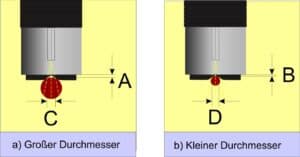
Optimised contact surface for colour measurement on cables of varying diameters
Practical Solution for Colour Measurement on Cables and Wires
For precise measurement on cables, it is essential that the probe head rests perfectly on the curved surface. The sph900, with its external probe heads and numerous adapter solutions, offers clear advantages here. They can be flexibly adapted to different cable diameters and also enable measurements directly in production.
Depending on the different cable diameters, various measurement options are available:
- Measurement using the 45°/0° probe head for cables with a large diameter
- Measurement using the 45°/0° probe head with integrated prism for medium diameters
- Measurement using d/8° measurement geometry with holder, adjustable prism and aperture for small diameters
- Measurement using d/8° measurement geometry for very thin cables and wires wound around a rod
The flexibility of the sph900 is one of the key advantages of this spectrophotometer for the measurement of curved surfaces.
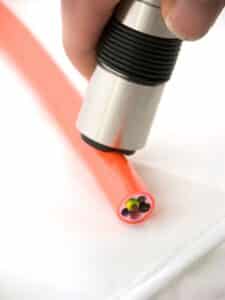
External measuring head with prism for reproducible and precise colour measurement
Making Measurement Data Secure and Traceable
The determined colour values can be stored directly in the device or transferred to a central database. This allows colour standards and measurement values to be secured over the long term and retrieved at any time – even if the original cable has already changed due to ageing. Interfaces such as USB or wireless connections enable integration into existing QA or SPC systems.
This turns colour measurement into an active tool for process monitoring in production and supports transparent quality documentation across all process stages.
FAQs
How are cables measured using colourimetry?
Cables are measured using spectrophotometers, which detect the reflected light at defined angles. The measurement is taken directly on the cable surface or – in the case of very thin wires – on coiled samples. The results are stored as objective colour values and compared with reference values.
How do you measure very thin cables or wires?
For cables with a very small diameter, it is advisable to wind them around a support rod or to measure them using a larger measuring surface. This creates a sufficiently large, homogeneous measuring zone to ensure reproducible results.
What role does the measuring head play?
The measuring head is crucial to the repeatability of the measurement. It must rest securely on the curved surface and minimise stray light. External measuring heads with adaptors offer clear advantages in this respect.
What are the sources of error in colour measurement?
Typical errors arise from uneven sample positioning, varying lighting conditions or insufficient contact between the measuring head and the cable. A standardised measurement method significantly reduces these factors.
At what stage of the process are measurements typically taken?
Colour measurements are carried out at goods-in, during production and at goods-out – wherever colour consistency and documentation are crucial.
Conclusion: Ensuring reliable colour consistency on cables
The colour of cables is a safety-critical quality characteristic and requires objective, reproducible testing. Visual assessments quickly reach their limits in this context. Portable spectrophotometers with flexible probe designs enable precise colour measurement even on small diameters and curved surfaces. This allows colour deviations to be detected at an early stage, documented and controlled over the long term.
Would you like to know how colour measurement on cables can be optimally integrated into your process?
We would be happy to assist you in selecting a suitable measurement concept – from sample preparation to data integration.
Get in touch with us!
