


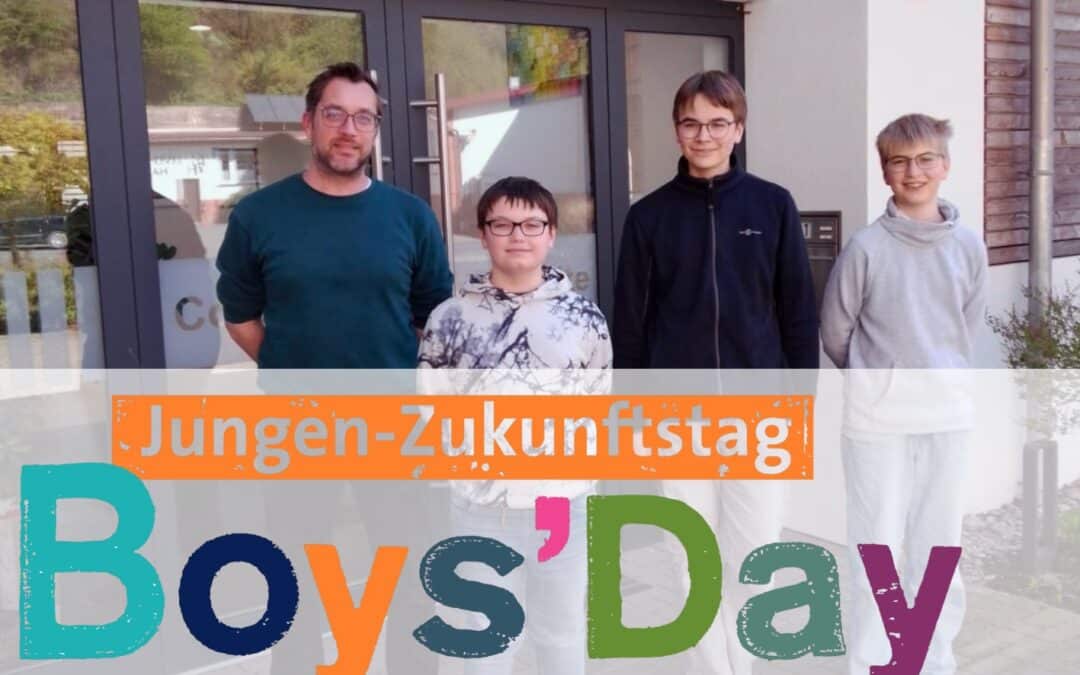
The Future Day offers an annual opportunity to experience companies and technologies at first hand and to gain insights into STEM careers. Companies, universities and institutions open their doors to give young people new perspectives and spark interest in technical and scientific fields.
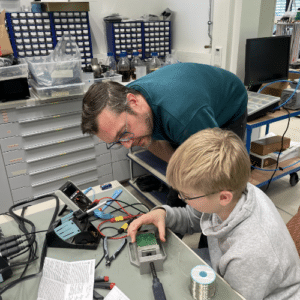
Fridolin soldering with Dennis Ziemann.
This very idea was once again at the heart of ColorLite’s participation.
On this year’s Future Day, held on 23 April 2026, we had the pleasure of welcoming three students from grammar school years 6, 8 and 9 to ColorLite. The participants came from the grammar schools in Osterode and Northeim and spent the day exploring our development, production, sales and marketing departments.
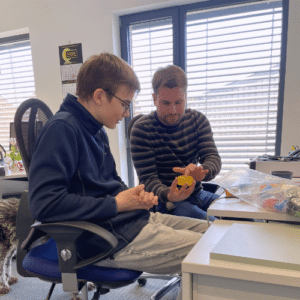
Lukas measuring samples, coached by Christoph Rode.
“Why are colours measured in the first place?” and “How does that actually work?” – these questions marked the starting point of the day and led the students straight into the practical part of their taster day.
In production, they had the opportunity to learn about electrical engineering processes and, under supervision, carry out their first hands-on tasks such as soldering circuit boards. They were guided throughout by Dennis Ziemann, who introduced them step by step to the practical work.
This naturally led to the next realisation: subjects such as physics and computer science form the foundation for many of the professions that make up a company like ColorLite. Concepts from physics lessons, such as light and colour, as well as topics from computer science like data processing and software application, became tangible in practice.
For the students Fridolin and Lukas Revermann, as well as Marlon Ziemann, it became clear how school knowledge can later be applied in very different fields—and that behind all theory, there is also practical value.
A particular highlight was the use of our 3D printer. The students were able to observe how digital models are transformed into real components. From the initial design to the finished object, the entire process was presented in a clear and understandable way—an exciting insight into modern manufacturing technologies.
Alongside the practical work, active participation also played an important role: in a short quiz, the students were able to test their newly acquired knowledge straight away. Questions about colour, technology and our company made it fun and showed how much they had already taken in.
🧠 Excerpt from the Future Day quiz: Test your knowledge of STEM careers
- What does ColorLite actually do?
☐ We measure colours.
☐ We plan holidays.
☐ We build devices for colour measurement. - Why do companies check their colours?
☐ So that their products always look the same.
☐ So that everything sparkles.
☐ So that customers can recognise the brand. - Which subjects are part of STEM?
☐ Mathematics
☐ Sports
☐ Technology - What can a 3D printer do?
☐ Build objects layer by layer
☐ Play music
☐ Mix colours - What is important in colour measurement?
☐ Consistent conditions during measurement
☐ As many colours as possible at once
☐ Loud working
👉 How many answers would you have got right?
Conclusion
The Future Day at ColorLite shows that STEM careers are diverse, hands-on and anything but boring. Days like these offer a valuable opportunity to bring school subjects to life and make their practical relevance tangible.
We wish this year’s participants continued enjoyment and success—perhaps we will see one or two of them again in a few years in the world of STEM careers.
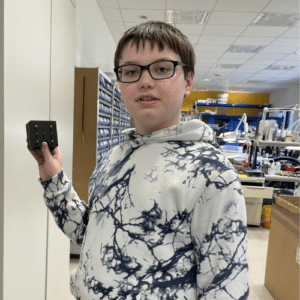
Marlon presents his self-built electronic dice, generating random numbers from 1 to 6 at the push of a button.
