



“Let there be light!” With these words, an ancient creation story begins. And in a sense, this is also where every act of colour perception starts. Without light, there would be no colours: no blue of the sky, no red of a blossom, no green of a leaf. Colour is not an isolated phenomenon. It emerges where physics meets biology, where neural processing encounters experience, and where language begins to organise perception. Anyone who speaks of colour is always referring to an interplay — and our perception of colour is an inherently interdisciplinary process..
Without light, no colour: the physical point of origin
When light strikes a surface, part of it is absorbed while another part is reflected. These reflected portions reach our eyes. From a physical perspective, this is electromagnetic radiation of varying wavelengths. What enters the eye is, at first, merely a stimulus — not yet a colour. Only through interaction with our visual system does it become what we perceive as “red”, “blue” or “green”. Colour is not a property of an object; it is a result, a shared construct.
Three cones and a first impression: how the eye works
On the retina, there are three types of colour receptors, known as cones. They respond with varying sensitivity to short-, medium-, and long-wavelength light. From the ratio of their activation, an initial neural signal is formed — a kind of raw version of the eventual colour impression. This principle of tristimulus vision is broadly similar in most people. In this respect, our biological makeup is remarkably alike. And yet, this is not where our experience of colour is determined. Between the signal from the eye and conscious perception lies a system that changes everything: the brain.
The brain has a say: colour constancy and context
Our brain does not process visual information neutrally. It compensates for lighting conditions, takes surrounding colours into account, and adjusts for shadows. A white sheet of paper appears just as white to us in sunlight as it does under warm indoor lighting, even though the spectral composition differs significantly. This phenomenon is known as colour constancy. Studies in perceptual research show just how strongly such processing shapes our impression of colour. Perception is not a simple reflection of reality; it is an active achievement. Everything we see has already been interpreted.
When language shapes colour: cultural influences on colour perception
That language can influence our perception is a key insight from linguistics, cognitive psychology, and perceptual research. These disciplines explore how people not only see stimuli, but also name them and organise them mentally. Studies show that different cultures use varying numbers of basic colour terms. Some languages make finer distinctions between colour ranges, while others group them more broadly.
The physiological foundations of vision remain the same, but linguistic categorisation can affect how quickly and how precisely shades are distinguished. A particularly vivid example comes from a study by Winawer et al. (2007): Native Russian speakers, whose language has two basic terms for blue (goluboy and siniy), were able to distinguish corresponding shades more quickly than English speakers — as long as no linguistic distraction was present.
This does not mean that people see different colours. But it does show that language can shape how we differentiate between them. Colour is not only perceived; it is also categorised.
Surface, environment and experience are additional influencing factors
Visual context also alters our perception of colour. Gloss affects brilliance, while surface texture influences how light is scattered. A matte surface appears different from a glossy one, even when the measured colour value is identical. Adjacent colours, brightness and background likewise play a role.
And we ourselves change, too. With age, the lens of the eye gradually yellows, and adaptation to specific lighting environments can shift perception. Our colour vision is not a fixed mechanism. It remains dynamic.
Colour emerges from interplay
Colour arises from the interplay of light, biological makeup, neural processing, language, experience and context. For this very reason, it cannot be assigned to any single discipline. Physics explains light. Biology describes the eye. Neuroscience examines processing in the brain. Linguistics and cultural studies show how we categorise colours. Psychology asks how we evaluate them. Colour moves between all these fields. It is interdisciplinary — and precisely for that reason, it is not an objective, isolated property of an object. Perhaps that is exactly where its fascination lies. It is not a static attribute of the world; it emerges from interplay.
And precisely because so many factors shape our perception of colour, reliable reference points are essential. Precise and repeatable colour measurement systems create comparability. They translate a subjectively experienced phenomenon into reproducible values, providing a shared basis wherever perception may vary.
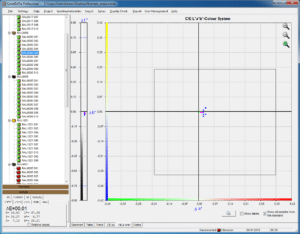
Color measurement software from ColorLite
