


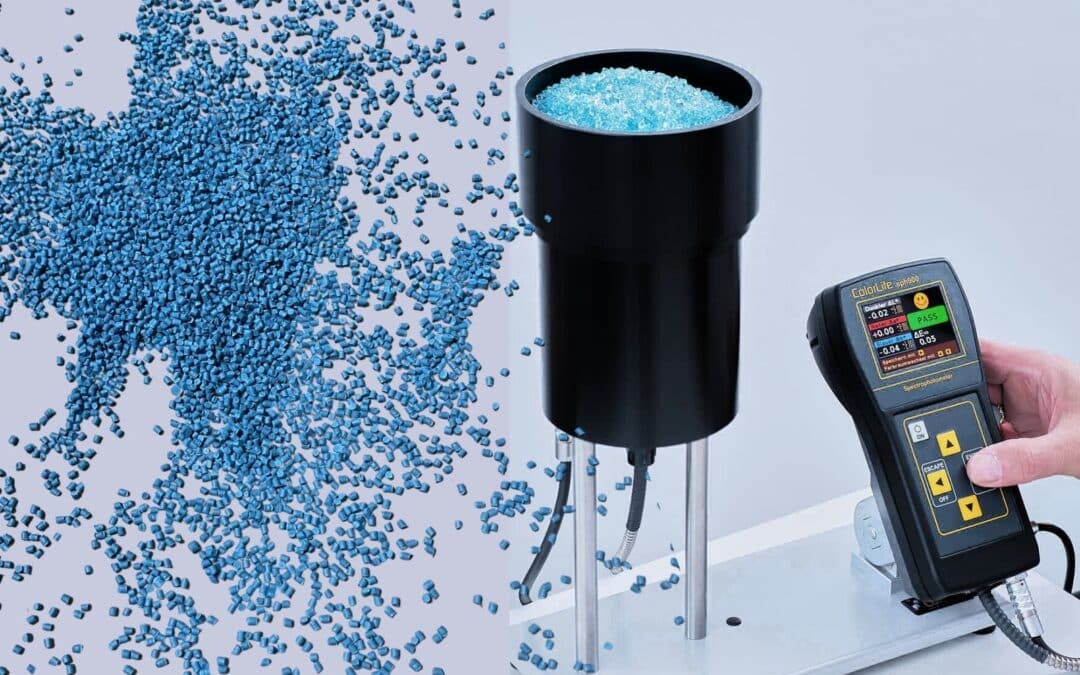
Why colour measurement of plastic granules places special demands.

Measurement setup of the sph900 for colour quality assessment of inhomogeneous samples

Simple adapter technology with automatic detection
Stable and reproducible measurement results therefore depend on three key factors:
- a sufficiently large measuring area
- a suitable measurement geometry
- a defined multiple measurement with averaging
Influence of measuring area and geometry on the measurement result
The colour measurement of plastic granules is typically carried out as a laboratory test under defined conditions. Due to the inhomogeneous surface and the scattering structure of the bulk material, the reflection properties differ significantly from those of homogeneous test samples. The sph900 MA80 set has proven effective in this context. Thanks to diffuse illumination with 0° observation, directional reflection effects are minimised, enabling reproducible colour values even for highly scattering materials such as granules.
Especially for inhomogeneous bulk materials, this geometry ensures:
- reduced sensitivity to changing particle orientation
- improved averaging of stress whitening effects
- more stable and comparable CIE Lab* values
In addition, the MA80 increases the measuring area to a diameter of 80 mm. This captures a significantly larger amount of material. As a result, local brightness variations of individual pellets have less influence on the overall result.
For reliable colour measurement of plastic granules, the following procedure is recommended:

Plastic granules in measuring cuvette for spectral colour measurement
- Carry out calibration using a PTB-certified white standard and a black reference
- Fill the cuvette approximately halfway with granules
- Start the measurement
- Gently shake the sample or refill it between measurements
- Perform at least three individual measurements (five recommended for highly inhomogeneous material)
- Use automatic averaging. Multiple measurements are essential for bulk materials. Only through averaging can variations caused by changing pellet orientations or cut edges be reduced
The measurement is carried out in reflection mode through the base of the cuvette, providing a more uniform optical reference surface than an open surface measurement; for stable and reproducible results, a clean glass plate, a consistent filling level for translucent samples, and temperature equilibration of the specimens (thermochromism) are essential.
Check the colour quality of your granules with the sph900 MA80 set – either stand-alone or digitally networked
The sph900 MA80 set can be operated as a stand-alone spectrophotometer: CIE Lab* values, ΔE deviations from the reference, and PASS/FAIL evaluations are displayed directly on the device, while automatic averaging of multiple individual measurements is carried out during the measurement process.
For extended documentation, the device can be connected to a PC via USB or network. In combination with the ColorDaTra Professional software, reference standards can be archived, measurement values visualised in the CIE Lab* diagram, trends analysed, and advanced ΔE formulas such as CMC or CIE94 applied. In addition, reports can be generated, data exported, and batches compared across different locations.
Alternative systems for colour measurement of bulk materials
n the field of spectral colour measurement of bulk materials such as plastic granules, masterbatch, compounds, plastic pellets, recyclates, regrind or pigment powders, ColorLite offers different system solutions depending on the test setup.
ColorLite ColorCube
A stationary system for fixed laboratory workstations with a large measuring area – ideal for recurring testing tasks in the quality control laboratory.
ColorLite sph ipm
Inline colour measurement directly within the production process for continuous monitoring of granules and compounds, as well as for the early detection of colour deviations during production.
Inline colour measurement directly within the production process for continuous monitoring of granules and compounds, as well as for the early detection of colour deviations during production.
How can plastic granules be measured reproducibly?
With a sufficiently large measuring area (e.g. 80 mm), a d/0° geometry, and at least three individual measurements with averaging.
Why do ΔE values fluctuate in granules?
Causes include stress whitening, changing particle orientation, varying filling levels, dust or temperature differences. A large measuring area and multiple measurements help to reduce these effects.
Which measurement geometry is suitable for granules?
A d/0° geometry (non-standardised) is suitable for bulk materials. The diffuse illumination ensures more stable measurement values for inhomogeneous materials.
How many measurements are advisable?
At least three individual measurements; for highly inhomogeneous material, five measurements with averaging.
Can the colour measurement of plastic granules be documented in an audit-compliant manner?
Yes – provided that the measurement procedure is defined and applied consistently. For audit-compliant documentation, the following points should be fulfilled:
-
defined measurement geometry (e.g. d/0° with MA80)
-
defined number of individual measurements with averaging
-
regular calibration using a certified white standard
-
documented reference values
-
traceable storage of measurement results
With the sph900, measurement values can be stored directly and documented as CIE Lab* values or ΔE. In combination with the ColorDaTra Professional software, reports can also be generated and measurement data archived.
Do you test masterbatch, compounds or pellets and want to achieve stable ΔE values? We will be happy to support you in selecting the appropriate measurement solution.
Get in touch with us!
📞 +49 (0) 5552 999 587
✉ Sales@colorlite.de
